

Christmas Tree Pesto Mozzarella Puff Pastry Twists
The pastry edges puff first, turning into crisp golden layers around the basil pesto and melted mozzarella. When I make Christmas Tree Pesto Mozzarella Puff Pastry Twists, I watch those…
Tip: save now, cook later.The pastry edges puff first, turning into crisp golden layers around the basil pesto and melted mozzarella. When I make Christmas Tree Pesto Mozzarella Puff Pastry Twists, I watch those edges closely; the top can look ready before the bottom has had time to crisp.
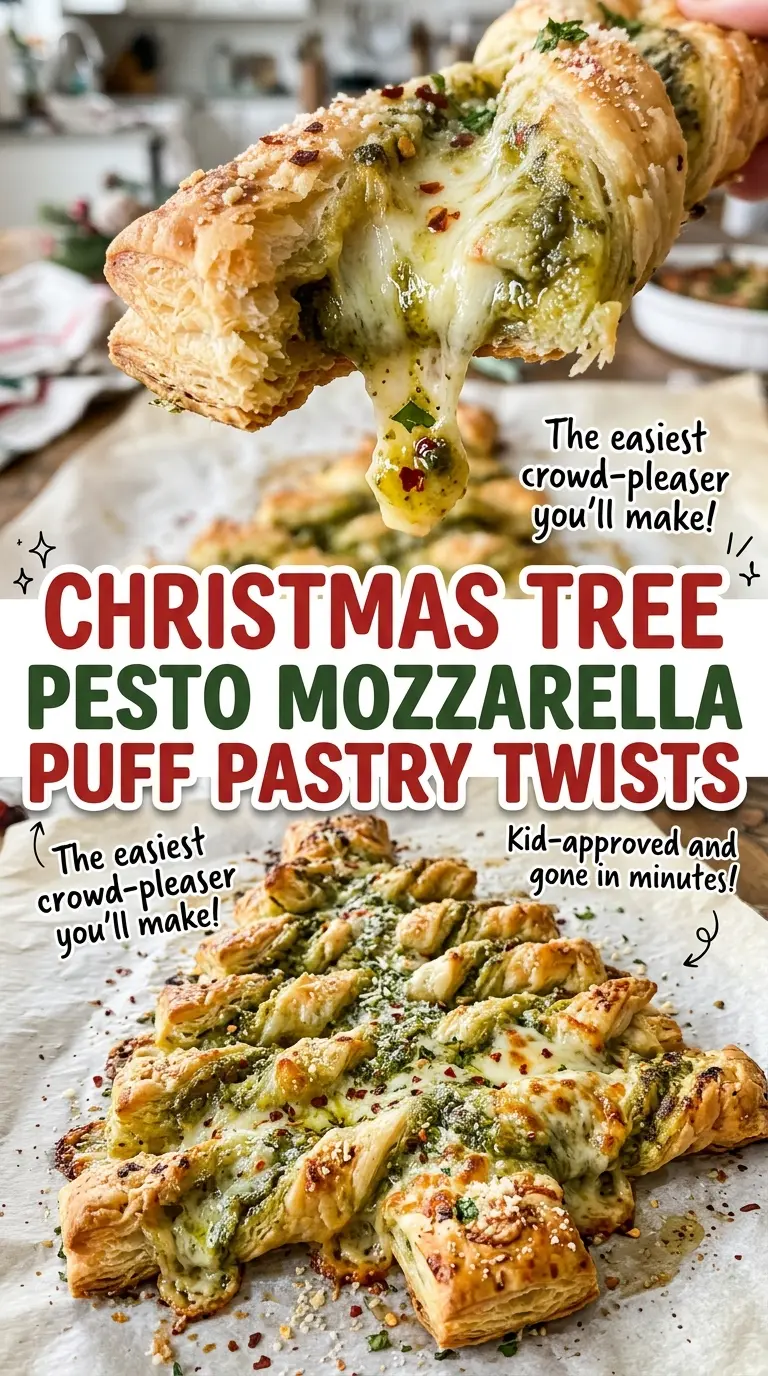
Two sheets of cold puff pastry make a sturdy, shareable tree, and the filling stays simple: pesto under a layer of mozzarella. The shape gives you plenty of flaky branches to pull apart, while the little trunk helps it sit neatly on the baking sheet. It’s a savory pastry with a crisp base and a warm, cheesy center.

Kitchen Note
That 15-minute rest in the refrigerator after shaping is worth the pause. The pastry firms up again, so the little branches are less likely to slump when they go into the oven.
Save these Christmas Tree Pesto Mozzarella Puff Pastry Twists for a crisp, golden centerpiece with pull-apart pesto-and-cheese branches.
The Half-Inch Spine Is What Keeps the Tree in One Piece
The cuts make the branches, but the uncut strip down the middle holds the whole shape together. Stop each cut half an inch from the centerline and you leave a continuous backbone of pastry beneath the twists. Cut through that center and the two sides can separate as the pastry puffs.
The outline matters, too. A centered point, a canopy that’s 9 inches wide and 8½ inches tall, and a 2-inch-wide, 1½-inch-long trunk give the branches room to spread without making the tree awkward to lift or serve. Keep the two pastry layers aligned before cutting; if one sticks out farther, the tree’s sides won’t match and the branches will puff unevenly.
Think of the shape as a connected pastry, not a stack of individual twists. Each strip should stay attached at the spine while it turns outward. That small bridge of pastry is what lets you pick up a branch without the tree falling into separate pieces.
Why Low-Moisture Mozzarella Belongs Between These Pastry Layers
- Puff pastry — Frozen pastry is convenient here, and the useful quality is how it handles: thaw it until pliable, but keep it cold so the sheets roll and cut cleanly. A different brand of frozen puff pastry is fine as long as you have two sheets that can be rolled to the required size. There isn’t a useful substitute that gives the same flaky layers.
- Basil pesto — Pesto brings the savory basil flavor and spreads into a thin layer between the pastry. A store-bought basil pesto works well; choose one you like eating on its own, since its flavor comes through clearly. Another brand of basil pesto is the simplest swap, with no change to the method.
- Low-moisture mozzarella — This melts into the filling without adding as much moisture as fresh mozzarella. Shredded cheese is ready to scatter evenly; if you buy low-moisture mozzarella in a block, shred it before assembling so it distributes across the pesto. Fresh mozzarella isn’t an equal swap here because its extra moisture can leave the pastry underneath damp.
- Egg and water — Beating them together makes a wash that helps the outside bake to a deep golden color. Beat until the white and yolk are blended, then brush a thin coat over the shaped pastry so it doesn’t collect in the cuts.
How to Shape the Branches Without Losing the Tree
Roll the pastry while it’s still cold
Heat the oven to 400°F and line a 13×18-inch rimmed baking sheet with parchment. Roll each pastry sheet on a clean work surface to 10×11 inches, using gentle passes rather than pressing hard. The dough should lie flat and bend without cracking. If it feels soft and sticky under the rolling pin, pause before shaping so the layers don’t smear together.
Layer pesto and mozzarella evenly
Set one pastry sheet on the lined baking sheet and spread the basil pesto across it, leaving a ½-inch border. Scatter the mozzarella evenly over the pesto rather than piling it in the center. That even layer gives each branch filling, while the bare edge helps the top sheet meet the bottom sheet. Keep the border clear so filling doesn’t sit right at the seam.
Cut the tree outline through both sheets
Lay the second sheet over the filling and align its edges with the first. Cut through both layers to make a centered point and a canopy 9 inches wide and 8½ inches tall, with a centered trunk 2 inches wide and 1½ inches long. Remove the scraps around the silhouette. Taking a moment to align the sheets before cutting makes it easier to get matching sides.
Cut and twist the branches
Cut horizontal strips about 1 inch apart along both sides of the canopy, stopping each cut ½ inch from the centerline. Twist each strip outward one or two times; use one turn for the short upper branches so they don’t feel crowded. Once the tree is shaped, refrigerate it for 15 minutes. Beat the egg with the water in a small bowl, then brush the mixture over the pastry.
Bake until the base is crisp
Bake for 20 to 25 minutes, until the pastry is puffed and deep golden brown and the bottom is crisp. The top’s color is only part of the cue; check that the base has baked through rather than taking it out as soon as the branches look browned. Let the tree rest on the baking sheet for 5 minutes before serving so the hot cheese settles slightly.
Two Small Changes That Give the Tree a Different Finish
A lighter, crisper center
Use a little less mozzarella and pesto for a less-filled version. The pastry has more room to puff and the center is less rich, though you’ll get a lighter layer of filling in each branch.
A matte, egg-wash-free top
Skip the egg-and-water wash if you prefer not to use egg. The pastry will still bake, but its surface will be paler and more matte instead of glossy and deeply golden.
Storage and Reheating
- Refrigerator: Store leftovers in an airtight container for up to 3 days. The pastry will soften as it sits.
- Freezer: Freeze cooled leftovers in an airtight freezer-safe container for up to 1 month. The pastry may lose some crispness after thawing.
- Reheating: Warm in a 400°F oven until heated through and crisp again. Keep an eye on the already-browned pastry so it doesn’t get too dark.
Questions That Come Up When Making This Puff Pastry Tree
Christmas Tree Pesto Mozzarella Puff Pastry Twists
Ingredients
Equipment
Method
- Preheat the oven to 400°F.
- Line a 13x18-inch rimmed baking sheet with parchment paper.
- Gently roll each pastry sheet on a clean work surface to 10x11 inches.
- Place one sheet on the prepared baking sheet.
- Spread the pesto over it, leaving a 1/2-inch border.
- Sprinkle the mozzarella evenly on top.
- Place the second pastry sheet over the filling and align the edges.
- Cut through both layers into a tree shape with a centered point, a 9-inch-wide canopy 8 1/2 inches tall, and a centered trunk 2 inches wide and 1 1/2 inches long.
- Remove the scraps.
- Cut horizontal strips about 1 inch apart along both sides of the canopy, stopping each cut 1/2 inch from the centerline to leave a central spine.
- Twist each strip outward 1 to 2 times, using one turn for the short upper branches.
- Refrigerate the shaped pastry for 15 minutes.
- Beat the egg with the water in a small bowl.
- Brush the egg mixture over the pastry.
- Bake for 20 to 25 minutes, until puffed and deep golden brown and the bottom is crisp.
- Let the pastry rest on the baking sheet for 5 minutes before serving.