
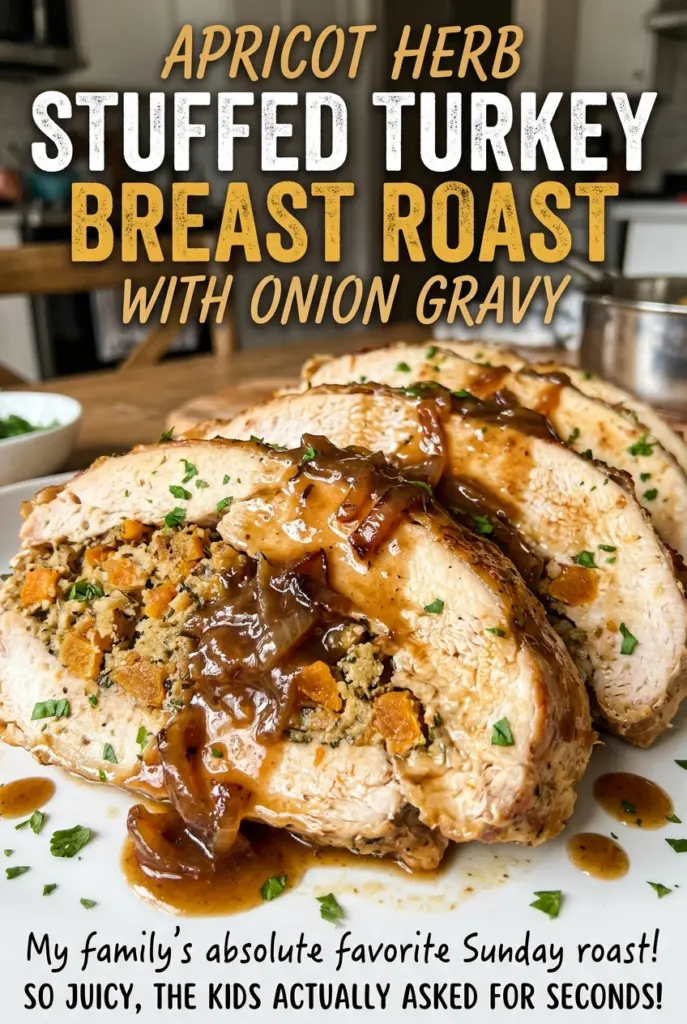
Apricot Herb Stuffed Turkey Breast Roast with Onion Gravy
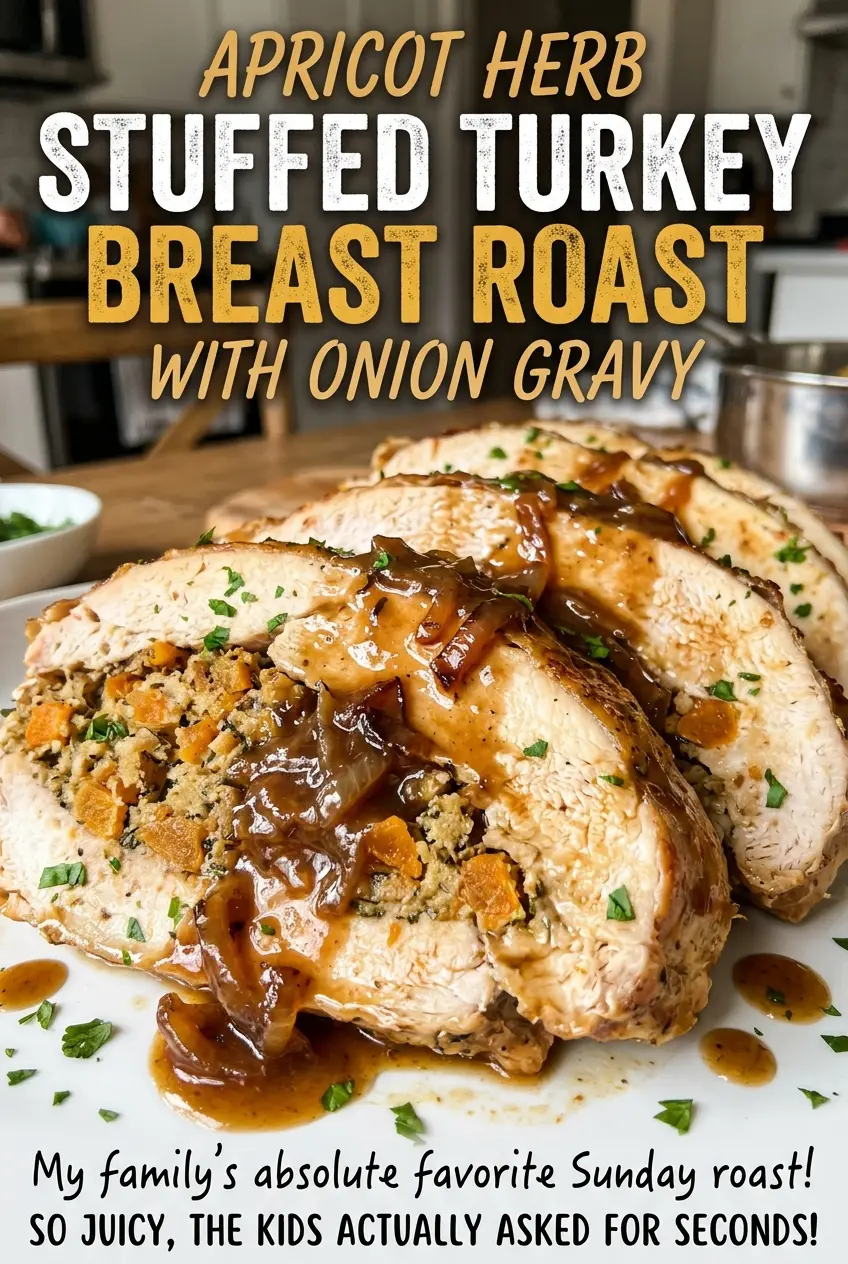
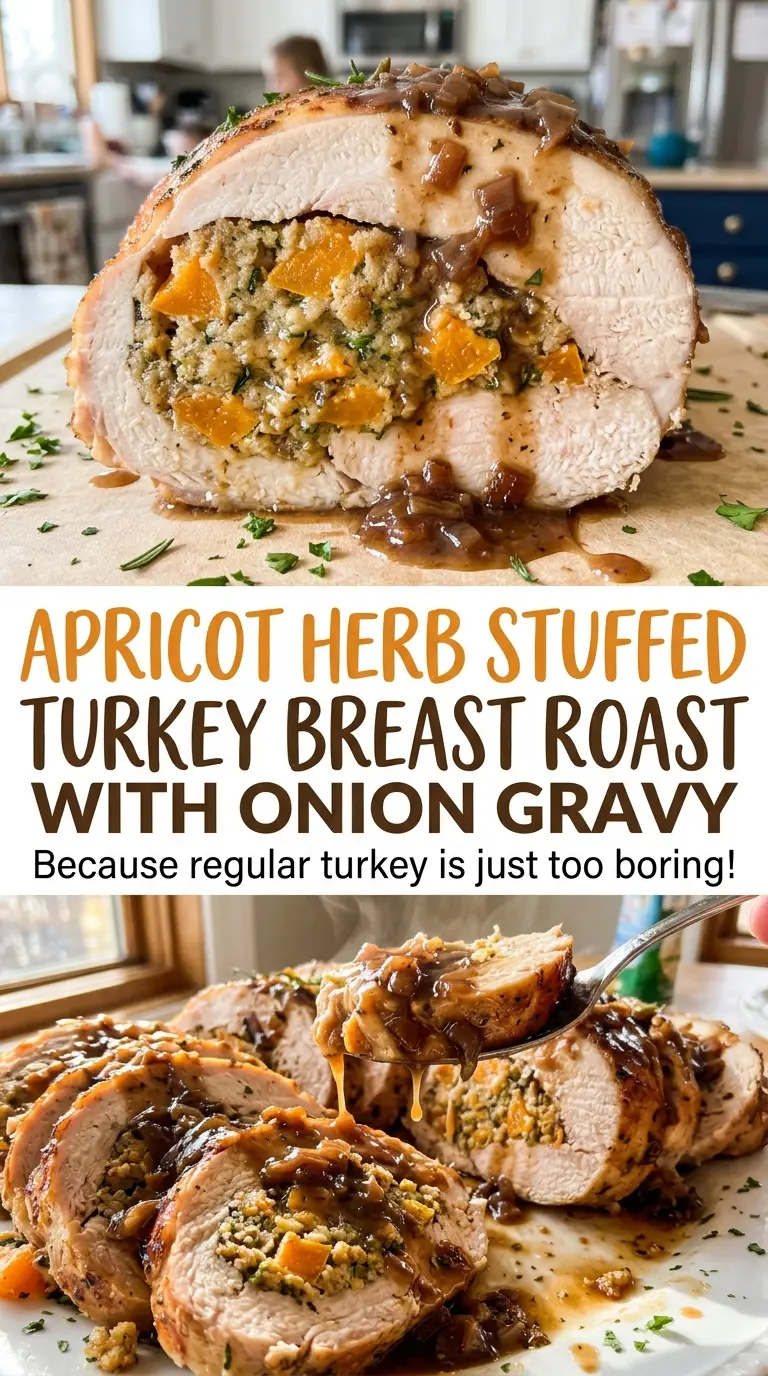
The first slice of a stuffed turkey breast tells you whether the roll held: the stuffing should show in a neat spiral instead of spilling onto the board. This apricot…
Tip: save now, cook later.The first slice of a stuffed turkey breast tells you whether the roll held: the stuffing should show in a neat spiral instead of spilling onto the board. This apricot herb stuffed turkey breast roast is rolled around a savory bread filling with little pockets of fruit, then roasted over sliced onions that become part of the gravy. It makes a lovely centerpiece without needing to roast a whole bird.
I like how the same pan gives the roast and gravy a connected flavor. The chopped onion and celery soften in butter for the stuffing, while the sliced onions underneath the turkey cook in broth and catch the pan juices. Let the stuffing cool completely before rolling, and the turkey is much easier to handle. After a short rest, the slices stay together, tender and full of herbs, with onion gravy ready to spoon over the top.
Kitchen Note
Let the stuffing cool completely, about 20 minutes, before spreading it over the turkey. If it’s still warm, it softens the bread further and makes the filling harder to handle as you roll.
Save this apricot herb stuffed turkey breast roast with onion gravy for tender slices, fruit-studded stuffing, and rich pan gravy.
Why the Onion Bed Belongs Under the Turkey, Not in the Stuffing
The two preparations of onion do different jobs here. Finely chopped onion cooks with the celery and becomes part of the bread stuffing; the sliced onions spread across the roasting pan create a bed for the rolled breast. As the turkey roasts, broth in the pan keeps that bed from scorching and collects the drippings that will season the gravy.
That division matters because the gravy needs more than broth and flour to taste like it belongs with the roast. The roasted onions are transferred into the finished gravy, and the strained pan juices bring along the savory flavor left behind in the pan. Keep the onions in the pan rather than setting the turkey directly on the bare metal, and you’ll have flavorful onions to fold into the sauce instead of scraps stuck to the bottom. It’s a small bit of planning that gives the gravy its depth without adding another ingredient.
What the Apricots, Bread, and Fresh Herbs Bring to the Stuffing
- Day-old bread cubes — Slightly dry bread absorbs broth while keeping some shape, so the stuffing holds together instead of turning pasty. Cut the pieces evenly to the specified 1/2-inch size; a fresh, soft loaf can soak up liquid faster and make a softer filling.
- Dried apricots — Their concentrated sweetness gives the savory herbs a bright contrast. Chop them finely so each slice gets some fruit rather than a few large, chewy pieces. A soft, pliable bag of apricots is easier to chop than fruit that has dried out and become tough.
- Fresh sage, thyme, and parsley — Sage and thyme give the stuffing its woodsy, savory character, while parsley keeps the mixture tasting fresh. Use fresh herbs here as listed; dried herbs have a different intensity and won’t give the same texture.
- Boneless, skinless turkey breast — The boneless breast can be opened, pounded evenly, and rolled around the stuffing. Choose one in the stated size range so the filling and roasting time stay in proportion. Pat the outside dry before adding the oil and seasoning.
- Low-sodium chicken broth — Broth moistens the bread and supports the onions in the roasting pan, then helps build the gravy. Low-sodium broth leaves room for the recipe’s salt without making the finished sauce too salty.
- Unsalted butter and yellow onions — Butter carries the flavor of the softened vegetables and forms the gravy base; unsalted butter gives you more control over seasoning. The chopped onion goes into the stuffing, and the sliced onions become the bed and gravy addition.
How to Roll the Turkey and Turn the Pan Juices Into Gravy
Soften the Vegetables and Season the Bread
Melt the stuffing butter in a skillet over medium heat, then cook the finely chopped onion and celery for 5 to 7 minutes, until softened. Stir in the chopped apricots for 1 minute; they should warm through without sticking. Toss the mixture with the bread cubes, sage, thyme, parsley, salt, and pepper, then stir in the measured broth. The bread should be moistened throughout, not swimming in liquid.
Open the Breast and Build an Even Roll
Heat the oven to 350°F. Cut the turkey horizontally almost all the way through and open it like a book, then pound it to an even 1/2-inch thickness so it cooks consistently. Spread the cooled stuffing over the surface, leaving a 1-inch border around the edges. Roll from a long side and tie with kitchen twine at 1 1/2-inch intervals; a consistent roll helps the slices hold their shape.
Roast Until the Center Is Cooked Through
Arrange the sliced onions in a 9×13-inch roasting pan and pour in the roasting broth. Set the turkey seam-side down on the onions, brush it with olive oil, and season with the remaining salt and pepper. Roast for 1 1/4 to 1 3/4 hours, beginning to check after 1 hour; cooking time varies with the roast’s shape and thickness. Check both the thickest turkey meat and the center of the stuffing with a thermometer, and remove the roast when both reach 165°F, then rest it on a cutting board for 15 minutes.
Strain the Drippings for a Silky Onion Gravy
Move the roasted onions to a bowl, then pour the pan juices through a fine-mesh strainer into a measuring cup and skim off excess fat. Melt the remaining butter in a saucepan over medium heat, whisk in the flour, and cook for 1 minute so the flour loses its raw taste. Gradually whisk in the gravy broth and strained pan juices, keeping the whisk moving to break up lumps. Simmer for 5 to 8 minutes until thickened, then stir in the onions and any juices released by the resting turkey.
Two Useful Ways to Adapt This Turkey Roast
Make the stuffing and gravy gluten-free
Use day-old gluten-free bread cubes in place of the regular bread, keeping the same cut size, and use a cup-for-cup gluten-free flour blend for the gravy roux. The stuffing may have a slightly different texture depending on the bread, but the roast and onion gravy still come together with the same method.
Blend the onions into a smooth gravy
For a smoother finish, blend the roasted onions with a little of the prepared gravy, then stir that mixture back into the saucepan. You’ll keep the onion flavor while losing the sliced-onion texture; leave the onions whole if you prefer a more rustic sauce.
Storage and Reheating
- Refrigerator: Store the turkey, stuffing, and gravy in airtight containers for 3 to 4 days. The stuffing softens as it sits, but the slices stay easy to serve.
- Freezer: Freeze sliced turkey and gravy in airtight, freezer-safe containers for up to 2 to 3 months for best quality. Thaw overnight in the refrigerator; the stuffing may be softer after thawing.
- Reheating: Warm covered portions in a 325°F oven with a little gravy until the turkey and stuffing reach 165°F. Reheat gravy separately over low heat, stirring often; high heat can make it reduce too quickly.
Questions That Come Up With a Rolled Turkey Breast
Apricot Herb Stuffed Turkey Breast Roast with Onion Gravy
Ingredients
Equipment
Method
- Melt 2 tbsp butter in a skillet over medium heat.
- Add the finely chopped onion and celery, and cook for 5 to 7 minutes until softened.
- Stir in the apricots and cook for 1 minute.
- Toss with the bread cubes, sage, thyme, parsley, 1/2 tsp salt, and 1/4 tsp pepper.
- Stir in 1/3 cup broth and cool completely, about 20 minutes.
- Heat the oven to 350°F.
- Butterfly the turkey breast by cutting it horizontally almost all the way through and opening it like a book.
- Pound the turkey breast to an even 1/2-inch thickness.
- Spread the cooled stuffing over the turkey, leaving a 1-inch border.
- Roll it up from a long side and tie with kitchen twine at 1 1/2-inch intervals.
- Arrange the sliced onions in a 9x13-inch roasting pan and pour in 1 cup broth.
- Set the roast seam-side down on the onions, brush with olive oil, and season with the remaining 1 tsp salt and 1/2 tsp pepper.
- Roast for 1 1/4 to 1 3/4 hours, beginning to check after 1 hour, until both the thickest turkey meat and the center of the stuffing reach 165°F.
- Transfer the roast to a cutting board and rest for 15 minutes.
- Transfer the roasted onions to a bowl.
- Pour the pan juices through a fine-mesh strainer into a measuring cup and skim off excess fat.
- Melt the remaining 2 tbsp butter in a saucepan over medium heat.
- Whisk in the flour and cook for 1 minute.
- Gradually whisk in 1 cup broth and the strained pan juices, bring to a simmer, and cook for 5 to 8 minutes until thickened.
- Stir in the onions and any juices from the resting turkey.